UN Telecommunications Body Requires Iran to Stop Satellite Jamming
Rights Groups Prompt Tougher International Laws Regarding Jamming
(22 February 2012) The International Campaign for Human Rights in Iran today welcomed a new International Telecommunication Union (ITU) regulation requiring governments take “necessary action” to stop jamming of satellite broadcasts from within their jurisdiction.
The ITU and its member states should immediately start monitoring Iran’s compliance with the new regulation and take any additional steps needed to ensure Iranian authorities stop interfering with satellite broadcasts, the Campaign added.
“This is the first meaningful action taken by the ITU and the UN to make legal provisions to counter censorship of satellite programs within various countries,” said Aliakbar Mousavi, former Iranian MP who served as deputy head of the Parliamentary Telecommunications Committee.
At the ITU’s 2012 World Radiocommunication Conference (WRC-12) last week, 153 of the 165 member states in attendance voted to amend their telecommunication regulations. The new amendment regarding jamming reads, “If an administration has information of an infringement [of the governing telecommunications regulations] committed by a station under its jurisdiction the administration shall ascertain the facts and take the necessary actions.”
WRC regulations constitute a legally binding international treaty on radio-frequency and satellite broadcasts. The amendment, approved on 17 February 2012 in Geneva, makes particular reference to infringements of Article 45 of the ITU’s Constitution, which prohibits “harmful interference” with broadcasts.
“The Iranian regime will have no more excuses to breach these regulations. I hope similar steps will be taken by the ITU regarding Internet censorship in countries like Iran as well,” said Mousavi, a longtime advocate of freedom of information and expression.
The WRC-12’s decision came after the Campaign, other human rights organizations, and broadcasters called on governments, corporations, and international telecommunication bodies to take action to stop satellite jamming. Just last month, the Campaign urged the WRC-12 to take decisive steps to end the Iranian government’s illegal and widespread jamming of satellite signals.
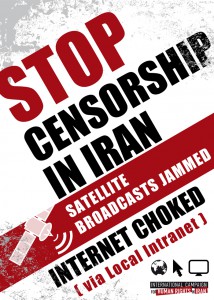
Satellite jamming and Internet censorship in Iran has increased dramatically since 2009. Targeted satellite stations such as BBC Persian, VOA, and other Persian-language news outlets operating outside Iran have become an important source of information for millions of Iranians inside the country, where independent media outlets are severely censored and repeatedly shutdown.
The ITU, the telecommunications arm of the United Nations, has received numerous complaints about the jamming of Persian and Arabic broadcasts in Iran and Syria on satellites carried by Eutelsat and Arabsat.
Nobel Peace Prize laureate Shirin Ebadi and the Campaign’s spokesperson Hadi Ghaemi expressed concern that Eutelsat, whose satellites host Iran’s state media network the IRIB, and other telecommunications companies have done little or nothing to hold Iran accountable for its censorship. Eutelsat’s failure comes despite the fact that much of the Islamic Republic’s jamming is aimed at other Eutelsat clients, BBC Persian and Voice of America (VOA), and the IRIB has itself been implicated in gross human rights violations for producing televised forced confessions of prisoners of conscience.
“The ITU has now made Iran’s legal obligations perfectly clear. But the international community, including telecommunications corporations like Eutelsat, needs to sustain its efforts to make sure Iran stops jamming satellite broadcasts,” said Ghaemi.