The Deterioration of Prison Conditions in Iran: 13 Thousand Inmates Packed in a Prison with Three Thousand Capacity
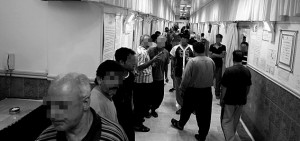 Last week, the Prosecutor General of the Revolutionary Court of Mashhad, Mahmoud Zoghi, told journalists that the Central Prison in the northeastern city of Mashhad, whose nominal capacity is 3,000 inmates, is currently holding more than thirteen thousand inmates. This points to the severe congestion of inmates in Iranian prisons, a problem that has been raised before. Officials have announced in various statements that the number of inmates in prisons throughout the country is anywhere from three to eight times their actual capacity.
Zoghi, who spoke at the City Council of Mashhad on 7 November 2011, said, “The statistics of the Central Prison of Mashhad, Camp Chenaran and the Corrections and Rehabilitation Center of Mashhad, say that they hold on average 15 thousand and 9,953 prisoners, respectively.” Mostafa Pour Mohammadi, the head of the National General Inspector’s Office, also said on 22 October 2011, “We currently have three times the capacity of prisoners in our prisons. Of course the problem is that in light of population growth, we have not built any new prisons.” However, on 29 June 2011 the newspaper Sharq quoted Azatollah Yousefian, a member of the Judicial Commission of the Parliament, saying, “Prisons are housing eight times their capacity.”
The notable discrepancy between the capacity of prisons and the actual number of inmates and the similar problems which they all face in prison cause serious issues for prisoners and their families. In many of the interviews conducted by the International Campaign for Human Rights in Iran, prisoners and their family members have pointed to the serious shortage of medical attention, the poor hygienic conditions of the prisons, poor nutrition, and serious psychological and mental hardships as some of the most critical issues impacting the health of prisoners.
The Campaign previously published a report about Ward 350 of Evin Prison which stated that more than 100 prisoners of conscience were being held in five rooms in which the empty space in each room (aside from the beds) was smaller than fifteen square meters. A reliable source told the Campaign that while Ward 350 is composed of nine rooms, as of 9 May 2010 four rooms of the top floor were assigned to the prison workers (ordinary prisoners who work within Evin Prison.) The population congestion is the cause of the decreased level of hygiene and has caused illnesses to be spread easily throughout the prison population. Prisoners are seriously and continuously affected by the lack of sufficient care by doctors. The blankets and linens of this ward were usually dirty and unhygienic and the bathrooms that double as kitchen sinks for dishwashing are worsening the hygienic environment.
Ali Kantouri, a human rights activist who was imprisoned in Ghazal Hessar Prison in Karaj, previously spoke with the Campaign about the conditions of this prison: “The General Ward contains very small rooms and when a high population is packed together inside, when there is one sick person it quickly can spread and threaten every inmate in that room. If someone has a cold it infects everyone in that ward.”
Kantouri also spoke about his own health conditions and described what has become known among prisoners as ‘prison fever.’ “I became sick with a fever and severe chills within two or three days of entering [the ward] and I asked them to take me to the clinic. I waited a few days and suffered from fever and chills until they took me to the doctor. When I requested the doctor because of the medical emergency, the medical staff said it’s nothing. They said it’s prison fever. Another experience was when I became asthmatic. I had a serious cough for a month and a half to the point where it didn’t let the others sleep well. Whether it was on the floor or on the bed, we had to use every blanket we had. Obviously in a room with no sun and infected by lice these things become common.”
Kantouri added that people who suffer from serious medical illnesses are in need of urgent care outside of prison because, despite their multiple requests, no actions were taken to treat them. These prisoners include Hossein Ronaghi Maleki, Abdollah Momeni, Keyvan Samimi, Heshmatollah Tabarzadi, Ali Tari, Ghassem Shole Saadi, Issa Saharkhiz, Shabnam Medadzadeh, and Hamed Rouhinezhad. These are only some examples of political prisoners whose poor conditions in prison and the serious deterioration of their health have been discussed in the media.
Many prisoners have given eyewitness accounts of the prevalence of “floor sleeping” due to the congestion such that most prisoners can only find space on the floors to sleep, which causes extreme hardship particularly in the cold winter months. According to prisoners and their families, floor sleeping is common in Mati Kola prison in Babol, Karoon Prison in Ahvaz, and Ward 350 of Evin Prison in Tehran.
Aside from the increase in population, prisoners are also affected by the type and amount of food they receive. The son of Heshmatollah Tabarzadi, the secretary of the Democratic Front who is currently in Rajaee Shahr Prison if Karaj, told the Campaign recently about his concern for his father’s condition. He noted the long periods of time spent in an enclosed space, with poor ventilation and poor nutrition, have given his father rickets and digestive problems.
Most family members of prisoners who conduct interviews with the media talk about the prisoners’ numerous physical and psychological problems, all of which the prisoners did not have before going to prison. At the same time, judicial authorities have remained silent about addressing and reforming the situation.