UN Report Documents Iran’s Human Rights Crisis
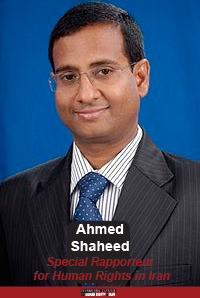 (15 October 2011) The Iranian government should immediately allow access to the UN appointed Special Rapporteur Ahmed Shaheed to address Iran’s ongoing human rights crisis, the International Campaign for Human Rights in Iran said today, following the release of Shaheed’s interim report.
The interim report by the Special Rapporteur documents the multi-faceted human rights crisis gripping Iran. It provides details of the persecution and prosecution of civil society actors, including political activists, journalists, students, artists, lawyers, and environmental activists; as well as the routine denial of freedom of assembly, women’s rights, the rights of religious and ethnic minorities, and the skyrocketing rates of executions.
The Iranian government has so far rejected any cooperation with Shaheed’s mandate. The report is based on first-hand testimonies of victims as well as interviews with Iranian human rights and civil society actors conducted outside of Iran.
“This report demonstrates that the Iranian government can run from the truth but cannot hide from it. The depth and details of the human rights crisis in the country, documented in this report, obligate UN member states to demand full compliance from Iran regarding its international commitments,” said Hadi Ghaemi, the Campaign’s spokesperson.
In his report, Shaheed notes several requests to engage with the Iranian government, all of which have been unanswered. On 19 October, Shaheed will make a formal presentation of his findings to the UN General Assembly in New York.
Shaheed’s report is released on the heels of an annual report by the Secretary General, Ban Ki-Moon, which also confirmed the continuing and deteriorating human rights situation in Iran.
The Campaign called on UN member states to take a strong and unified stance in support of the Special Rapporteur’s mandate and use all diplomatic means to urge Iran to cooperate with it.
The Special Rapporteur’s report highlights the house arrest of opposition leaders Mir Hossein Mousavi and Mehdi Karroubi who have been under an extra-judicial confinement since 14 February 2011.
The interim report notes “certain practices that amount to torture, cruel, or degrading treatment of the detained, the imposition of the death penalty in absence of proper judicial safeguards, the status of women, the persecution of religious and ethnic minorities, the erosion of civil and political rights — in particular the harassment, intimidation of human rights defenders and civil society actors.”
The extensive application of the death penalty, particularly the use of secret mass executions carried out in Vakilabad prison in the city of Mashad in absence of due process, is also highlighted in the Special Rapporteur’s interim report. It notes that in 2010, at least 300 secret executions were reported, as well as at least 146 such executions in 2011 carried out at Vakilabad. The Iranian authorities have been silent on these secret executions.
Despite time limitations on creating the report, it covers dozens of cases of individuals persecuted and prosecuted for their political beliefs and civil society and human rights activism.
The interim report also takes note of several letters written by prisoners detailing their torture and ill-treatment, as well as inhumane prison conditions, including letters by prisoners of conscience Abdollah Momeni, Ahmad Ghabel, and Omid Kokabee.
“We welcome the Special Rapporteur’s report which documents some of the most urgent issues facing the Iranian human rights community,” Ghaemi said.
The Campaign notes that Iran’s complete lack of cooperation with the Special Rapporteur’s mandate and the government’s continued refusal to allow him access to the country is an indication that it has no intention of taking meaningful steps to improve the human rights situation.