Iranian Judiciary Hangs Minor, Provides Unprecedented Justification
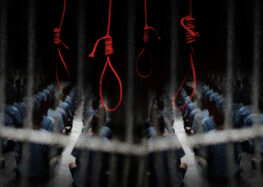
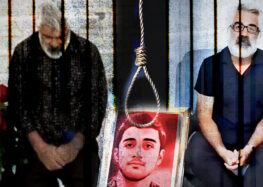
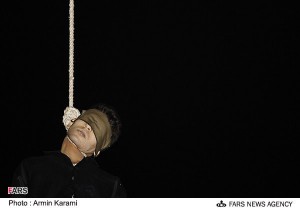 On Wednesday morning, the Iranian Judiciary hanged a minor for the murder of Iranian athlete Rouhollah Dadashi. Alireza Mollasoltani, who was not yet 18, had confessed to stabbing and murdering Dadashi with a knife. The public execution took place at 4:30 a.m. in Golshahr, Karaj, near Tehran. Though human rights organizations have repeatedly condemned the Iranian Judiciary’s execution of individuals under the age of 18, it is common for the Iranian Judiciary to keep convicts in prison until they turn 18 and then carry out their death sentences. Mollasoltani’s execution, however, was carried out even though he was a few months shy of 18.
Moments after the public hanging, Ali Rezvanmanesh, the Prosecutor’s Representative present at the execution, talked to Fars News Agency, justifying the execution of a minor by saying that the basis for determination of a convict’s age is not the the 365-day Iranian solar calendar, but the 355-day Arabic lunar calendar. “The determining factor in the law is the individual’s maturity according to Sharia, which is based on lunar calendar months. In this sense, the murderer had lived more than 18 years and therefore there existed no Sharia or legal impediments to carrying out the Qisas [retribution] against him. Of course, Alireza Mollasoltani was two months under the age of 18 according to solar months; [but] it is clear that the determining factor in the law is not the solar age, and we act according to Sharia-based maturity … The ruling was confirmed by 15 senior judges and subsequently by the Head of the Judiciary,” Rezvanmanesh told Fars.
On 17 October 2008, Hossein Zebhi, Judicial Deputy of the Prosecutor General told Iran’s state news agency IRNA that execution sentences for juvenile offenders will be replaced by life imprisonment sentences with the possibility of parole. “According to this directive, punishments for offenders under the age of 18 [in capital offence cases] will be reduced to life in prison in the first stage and in the second stage [of parole] will be reduced to 15 years in prison. In addition, in cases of good behavior and signs of rehabilitation, juvenile offenders may qualify for conditional release under Islamic compassion guidelines,” said Zebhi. (Source: https://iranhumanrights.org/2008/10/directive-to-abolish-juvenile-death-penalty-issued/)
Ali Rezvanmanesh’s Sharia-based justification for the execution of Mollasoltani contradicts the fact that Iran’s official calendar is based on the 365-day, solar Iranian calendar, and that according to international laws, the age of 18 is stipulated as the age of majority, also calculated based on a 365-day solar calendar.
Iran is a signatory to international conventions including the Convention on the Rights of the Child and the International Covenant on Civil and Political Rights, both of which strictly prohibit the execution of minors. Even so, child execution sentences are issued and implemented in Iran. Saudi Arabia, Yemen, Pakistan, and Sudan also execute minors.
According to ISNA News Agency’s report on Mollasoltani’s public execution, “prior to his execution, Alireza Mollasoltani, the murderer of Rouhollah Dadashi, repeatedly shouted the names of [Shia] Imams and asked for the pardon of the victim’s family and God’s forgiveness for his sins.” ISNA added that the execution had between three and four thousand spectators.