They Keep My Father In Prison For His Criticism of Khamenei, Says Son of Imprisoned Journalist
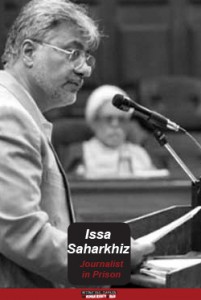 Mehdi Saharkhiz, son of journalist Issa Saharkhiz, who is currently serving his three-year prison term, told the International Campaign for Human Rights in Iran that his father has been sentenced to an additional two years in prison. “The new ruling against him is like the other ones. It displays the personal animosity of Mr. Khamenei against my father for his criticisms of Khamenei. Now they are trying to abuse him in whatever way they can and keep him in prison longer,” said Saharkhiz.
Issa Saharkhiz, a political activist who was former head of the National Press Department of Iran’s Ministry of Culture and Islamic Guidance during the Khatami era, is currently at Rajaee Shahr Prison in Karaj. On 5 August, he was sentenced to an additional two years in prison for his former journalistic activities. Saharkhiz was arrested in the aftermath of the disputed 2009 election, and Judge Salavati sentenced him to three years in prison at Branch 15 of Tehran Revolutionary Court on charges of “insulting the Supreme Leader” and “propagating against the regime.” During his two years in prison, Issa Saharkhiz has not been allowed one day of furlough.
Addressing the Leader of the Islamic Republic of Iran, Mehdi Saharkhiz said: “I would like to tell Mr. Khamenei personally that he should learn from Hosni Mubarak. One day, something exactly like this will happen for the Iranian government, maybe in one, two, or a few years; but Iranian government officials will also see the results of their actions like Saddam, Gaddafi, and Hosni Mubarak. I want to tell him that he should be afraid of the ending he will see in this world, and know that he will not be in power forever.”
“Mr. Saharkhiz is very weak; he has blood pressure problems, his ear drum has been torn, he suffers from backache, and he was even using a wheelchair for a while. He needs to be under the care of a specialist, but he is not allowed. During my father’s first days in prison, he was given something like a letter of repentance to sign. He was told that if he signed the letter, they would provide him with suitable and comfortable conditions, but my father told them that he believed in the things he had said and that he was not going to sign a letter of repentance. For this reason, they have kept him under very bad conditions inside prison and they never responded to his requests for furlough. Even so, I hope that my father, too, can be released on a few days’ furlough,” added Mehdi Saharkhiz.
Saharkhiz told the Campaign about other problems with his father’s conditions in prison. “First of all, my father should be at the Tehran Prison. Mr. Ejei, the man who once bit my father, has stated before that all prisoners who are from Tehran should be inside Tehran Prison, but this has not been the case for my father and many others, and this bothers us the most. Every two weeks at visitation time, my family has to go from one city to another, and spend half a day in transit in order to see my father for a few minutes. The other issue is that my family is always talking about how filthy the prison is. The Rajee Shahr Prison’s telephones have been cut off for the past year and only the [immediate] family can find out about his condition once every two weeks [at visitation time]. All of this is painful.”