Distinguished Director Talks About Wife’s Case and Women in Film
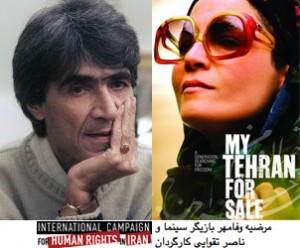
Nasser Taghvai (left) and Marzieh Vafamehr (right)
Distinguished Iranian filmmaker Nasser Taghvai spoke with International Campaign for Human Rights in Iran in an interview about the situation of his wife, Marzieh Vafamehr. Excerpts from the interview are below:
My wife’s temporary detention was extended for an additional month. One month has passed since Marzieh’s temporary detention and the judge had to decide the fate of the case. When I went to Branch 12 of the Culture and Media Court today, where my wife’s case is handled, I spoke with the judge for several hours. But in the end they said that because investigations in the case are not yet complete, her temporary detention has to be extended, and they didn’t even agree to set a bail for her. The judge told me that the case is out of his hands, that higher officials will have to decide, and that he has no choice other than extending her detention orders.
They contacted us on the phone. First we ignored them. Then they contacted us again, without sending the summons home. They promised me that they only needed Marzieh Vafamehr for a few questions and answers. They said, “If you tell her to come in, we will solve the problem through mediation.” They said, “We respect you personally, and we don’t wish for a case to be built against her.” They didn’t serve the summons. I told my wife, “Go, things will be resolved.” I trusted what they told me, but she went and did not return. The next day they issued her temporary detention orders for a month.
The case judge said that his charge is Shari’a-related and has to do with her acting in the film “My Tehran For Sale,” where in the first part she does not have a headscarf on, or she drinks in another part of it. The judge believes that she was really drinking alcohol on the film set. No matter how much I tried to tell him that nobody ever does such a thing on the set, it was futile. It is a given that our actors know all the red lines and would never do anything to jeopardize themselves personally. They say my wife’s charge is partnership in the production of this film, but a partnership is something entirely different from cooperation. What my wife has done was cooperation. Cooperation among film principles is routine all over the world. An actor may cooperate with a director or other film principles. The actor has to do whatever she is told on the set, otherwise she is not an actor. The actor is not at fault, she is just an actor.
About a meeting with officials from the government he said:
Earlier, I had spoken with Mr. Shamghadari, the Deputy [Ministry of Culture’s] for Cinema. He told me that when the Culture Minister returns from his trip they would have a meeting together. The meeting convened this morning and they were supposed to let me know the outcome by noon, but they have not contacted me yet and I’m still waiting. This meeting wasn’t just about my wife, but it included other women in cinema who have been arrested lately. In the end, the Ministry of Culture has to be accountable.
On maintaining silence on Vafamehr’s arrest for 15 days, Taghvai said:
I consulted with others and they said to let the issue be resolved in silence. We were hopeful that everything would be resolved in silence, but since a few days ago when the news broke in the media, and because some of the news was written with ill intentions or contained wrong information, I was forced to interview to give out accurate information.
About the pressures on female filmmakers and the film cited by officials in his wife’s case, he said:
They say this film did not have a production license and was an underground film. But when most of a film’s scenes are filmed on the streets of Tehran, how can it be an “underground” film? This is a word that has recently become fashionable. First, this film was made in 2008, and second, its subject was approved by the Ministry of Culture. Additionally, several of the film’s actors had come from Australia, which means their arrival most definitely was with visas and according to the law. A large portion of this film was filmed on the streets of Tehran. I mean when you take a simple camera to the street, the police would stop you a hundred times. How can one film with professional cameras make an illegal film without a permit? The rumor that says this film was illegal and without license is impossible.
All the actors in the film who are inside Iran have been interrogated, from those serving tea to the crew, to all the behind-the-scene elements, but all of them were released after a few hours. But for my wife’s release, they did not even agree to setting bail. They said she has to stay in prison until the case is completed. This is while the director, the lead actor, and other main actors of the film are abroad. Perhaps I’m expected to form a team to arrest the other actors and bring them in for interrogations in order to determine the fate of this case.
The pressure on female figures in cinema has increased, and I hope it does not continue and that my wife and others are released soon. My wife acted in this film that is directed by Granaz Moussavi in 2008. Moussavi emigrated to Australia many years ago. This film was a student project, and she came to Iran to do her university project on the subject of “Iranian youth.” Granaz and my wife were university classmates and therefore Marzieh became an actress in the film. This is a 60-minute student film and is not fit to be shown in cinemas at all. Some people have illegally copied and distributed it.