Shocking Confidential Report Admits to Iranian TV’s Provocation of Post-Election Uprising
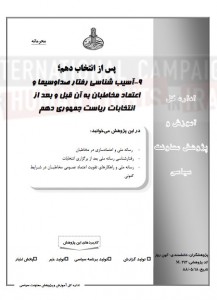
The Islamic Republic of Iran Broadcasting's confidential report acknowledges the IRIB's role in provoking post-election protests.
The International Campaign for Human Rights in Iran has obtained an exclusive copy of a confidential report prepared by a sub-division of the Islamic Republic of Iran Broadcasting (IRIB), in which the IRIB’s performance following the 2009 presidential election is seriously criticized and the network is held responsible for widespread protests arising from the announcement of the election results. The confidential report is dated 9 August 2009.
The report concluded that the IRIB’s mishandling of their reporting of the vote count process or the election results, and its failure to provide news coverage of the opposition candidates’ objections, led to public distrust of the election results and protests.
The report was prepared by the Education and Research Office of the Political Division of the IRIB and entitled “Analysis of the IRIB’s Conduct and Audience Trust Before and After the Presidential Election.”
The IRIB’s report, prepared only three months after the June 2009 presidential election, is stamped “Confidential” and appears to be for IRIB managers. The report states that “the vote count process, the initial election results, and the speedy announcement of the results… lead to the creation of doubts among people,” and “chatter” about “pre-determined election results.”
The report goes on to say that the “premature announcement of election results, prior to preparing public opinion, was a mistake in the national media’s news coverage … considering voting hours ended at 22:00 on the night of 12 June, and the initial results (announcing Ahmadinejad’s victory) were reported (after counting 61% of the votes) at 2:47 a.m. the next day .”
The report finds that “announcing election results with such speed was almost unprecedented.” The report implicitly blames the IRIB’s performance during the vote count, as one of the factors contributing to widespread street protest.
The Campaign has documented how immediately after the vote counting ended, Iranian security and intelligence forces and operatives from the Prosecutor’s Office executed a systematic and pre-planned set of arrests of prominent political activists, journalists, lawyers, and individuals responsible for the campaign headquarters of Mehdi Karroubi and Mir Hossein Mousavi.
Many of the people who were arrested during the days following the election were accused of inciting the public to participate in gatherings or of organizing the gatherings.
Security forces and government and military officials have repeatedly accused opposition leaders of organizing the spontaneous post-election protests. Many of those arrested were not even present at the gatherings.
In another section, the report elaborates on how the shortcomings of the national media caused dissatisfaction among the protestors:
“Lack of coverage of reactions from those objecting to election results during the first few days following the results announcement, and an emphasis on celebration and jubilation of the supporters of the winning candidate, inviting the public to the victory celebration of Mr. Ahmadinejad, and its live broadcast on radio and television networks—which, unfortunately, included sharp rhetoric against certain officials and some undesirable slogans chanted by people, which no doubt was not in the state’s best interest—and complete news silence about other candidates, are some of the other criticisms raised against the national media which have caused dissatisfaction among the protesters.”
The report admits that the IRIB’s failure to cover protests, which were broadcast by international media, led to the perception that the IRIB’s coverage was incomplete and inaccurate.
“Delayed dissemination of incomplete, nontransparent information, the lack of appropriate news about the protesters and the statements made by opposition candidates damaged people’s trust in the IRIB and the audience clearly learned that they could not receive the news in an exact, complete and correct way from the national media. —considering that other media, with different methods and specific intentions and goals covered the news, and people naturally accessed this type of information. Therefore, we witnessed people turning away from the national media and instead embracing foreign satellite networks.”
In some sections, the report praises the IRIB’s pre-election performance–which was generally considered more open and objective, In contrast the report states that “after polling ended,” the IRIB’s policies “suffered a sudden change in the wrong direction and occasionally regressed.” The report further observes “one of the reasons this subject [accuracy of election results] transformed into a political-security challenge, occasional riots, and death of several fellow-countrymen, was due to the sudden shift from the open atmosphere of the presidential election to obstruction in.”
Iranian authorities have repeatedly held dissidents, and specifically opposition leaders, responsible for the deaths of individuals during the peaceful protests that were repeatedly tainted by violence by security and police forces.
Another criticism raised in the IRIB report is the way in which the death of Neda Agha Soltan’s was covered, “which was reported after about a week and only in certain news sections in a minor way.”
According to the report’s authors, the IRIB’s conduct caused “unbearable pain and lethal hatred,” which they interpret to be “undesirable for the country, the revolution, and the regime.” The report further adds that a perception emerged that people were used as mere pawns in the election.
“The intensely undesirable feeling that people or supporters of candidates were used as mere pawns in the election, whereby at one point their feelings, emotions, and interests were recognized for creating excitement in the election, and immediately after the election ended, all the kindness and sweetness turned into lack of regard and unkindness. If the opposition candidates had an opportunity to speak their demands in state media as the ‘most trusted forum,’ their anger would have subsided and the volume of street protests and subsequent riots would have diminished,” the report stated.
The report also names “elimination and lack of reporting of certain news items in general and specific ways,” and “concentrating heavily on the activities and achievements of the Ninth Cabinet [Mahmoud Ahmadinejad’s previous term as president] a few months prior to elections,” as other factors that “damaged public trust” in the IRIB.
The Education and Research Office of the Political Division of the IRIB also named cases of “good conduct” prior to the election, including “honesty in the process of news dissemination,” “coverage of special cases,” and the “responsibility and role of media criticism.”
The Campaign considers this internal confidential report as another challenge to the legitimacy of post-election trials and convictions. The Campaign calls for immediate release of all post-election prisoners of conscience and a credible and independent investigation by an impartial committee to investigate the role of the Judiciary in these unfair trials and convictions.