Only One Month to Find, Sentence and Execute Suspects, Says Ahwazi Activist
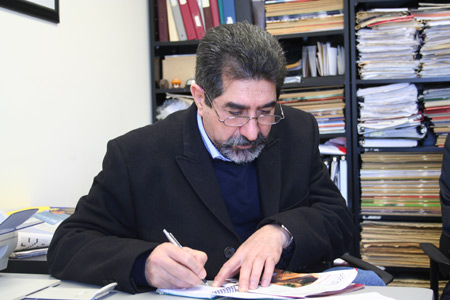
Activist for the rights of ethnic Arabs, Yousef Azizi Banitorof
Yousef Azizi Banitorof, Secretary of the Center for Combating Racism and Discrimination Against Arabs in Iran, who currently resides in London, spoke with International Campaign for Human Rights in Iran following news from the Al Arabiya website quoting Ahwaz News about recent executions in Ahwaz. “According to news we were able to receive from our contacts in Ahwaz, three people were hanged in public at Hamidieh Junction. They were three brothers by the names of Ali Heydari (25), Jassem Heydari (23), and Nasser Heydari (21). The hangings were viewed by eyewitnesses and there is no doubt that they took place. But another six were hanged inside Karoon Prison in Ahwaz, and nobody knows anything about it. Their families have not yet seen the bodies, nor were they informed at all in order to appear at the prison on the execution date. They, too, have only just heard this news,” said Azizi Banitorof.
Official sources only announced the names of eight of the nine executed individuals. Azizi Banitorof indicated that his sources in Ahwaz were also unable to find the name of the ninth individual. According to Ahwaz News’ website, five of the six executed individuals at Karoon Prison were Amir Moavi, Ali Na’ami, Amir Badavi, Ahmad Naseri, and Hashem Hamidi. The individuals are all from Ahwaz.
“Contrary to news from official Iranian sources that have stated their charges as ‘attacking the police’ and ‘acts against public chastity,’ we and local sources believe that the three brothers hanged at the Hamidieh Junction were active protesters during the 15 April demonstrations in Ahwaz this year. If the Islamic Republic of Iran disputes this assertion, they should allow independent human rights organizations to go to Iran and prove otherwise. They were kids from the Mallalshieh neighborhood. Mallashieh was the first spot in Ahwaz where the 15 April demonstrations started. We believe they were active in the protests and gathered people to participate in the demonstrations, and now the Islamic Republic has publicly executed them to intimidate the others,” said Azizi Banitorof about the charges against the executed individuals.
On 15 April the ethnic Arab population of Ahwaz and surrounding towns gathered to commemorate the 2005 protests, during which several protesters were killed and many others were arrested. During this year’s protests, several people were also killed and many were injured and arrested.
Reacting to the discrimination in this region, lawyer and Nobel Peace Laureate Shirin Ebadi wrote a letter to the United Nations High Commissioner of Human Rights, asking for a review of the events in Ahwaz. “Considering the geographic importance of the Khuzestan Province, and bearing in mind that Arab Iranians in the region have suffered from undue discrimination and currently live under unfavorable conditions, a widespread unrest in this region of Iran is probable,” wrote Ebadi.
“As Secretary of the Center for Combating Racism and Discrimination Against Arabs in Iran, I believe that the Iranian government wishes to seek revenge on that protest. The Hamidieh Junction is a location where residents of Ahwaz, Hamidieh, and Mallashieh frequent, and by using this location for executing the three brothers, perhaps they wished to intimidate the people of all three regions, so that they would not attempt demonstrations again. Who knows whether the six other individuals executed inside the Karoon Prison were former political prisoners, or whether they were arrested during the 15 April protests?” Azizi Banitorof told the Campaign.
“Official news sources have announced that the three brothers executed in public were charged with ‘armed attack on the police at an inspection stop in Ahwaz,’ but no objective eyewitnesses have confirmed this. The suspects did not have lawyers either, and the trial was held in a closed court session, behind closed doors. It is strange that in less than one month, the Islamic Republic found the murderer, sentenced him, and carried out the sentence, whereas these legal proceedings should have taken several months. Individuals should not be executed so easily and the sentence should not be finalized and carried out so quickly,”
“We witness executions of political activists inside the Ahwaz Prison from time to time; sometimes as ‘smugglers’ and sometimes as ‘rapists.’ The Iranian government has never tolerated Ahwaz’s ethnic Arabs,” added Azizi Banitorof.