Torture – Distortion & Disinformation
———————————————
I should stress again that torture is against our constitution, article 38, very explicitly. It is rarely in the constitutions of the country, torture is addressed. In our constitution, very explicitly it’s forbidden, it is a criminal act if it is done by any person, according to articles 570, 578, 598, of Islamic penal code. They will be pursued under the criminal act. We don’t have any difficulty with joining the convention banning torture. … There is only one point of reservation: that some of our punishment according to the law is considered by the convention as torture. Legal experts and legislative people in Iran, they consider that totally different. Torture is one thing and punishment is another thing. We are trying to work that out, to put some replacement for these punishments. But this needs legal process.39
– Mohammad-Javad Larijani at the HRC, 10 June 2010

Mohammad Nourizad addressed Supreme Leader Khamenei in a letter saying, “I suggest next time you comb your hair in front of a mirror, and when you spray yourself with cologne, you think about the heads of your country’s political prisoners, shoved into the toilets in their cells.”
The International Campaign for Human Rights in Iran has collected dozens of eyewitness and personal accounts of torture carried out by the Iranian government.40 Security forces reportedly resorted to torture during interrogations of detainees carried out after the post-election protests to coerce confessions. These confessions were often the only evidence used to convict detainees.41
Four protesters held in Kahrizak Detention Center died as a result of wounds they suffered under torture.42 Reported methods of torture include rape, severe beatings, sleep deprivation, threats of harm to family members, pouring ice cold water on prisoners with heart conditions after they have been subjected to intense heat, prolonged periods of solitary confinement, and deprivation of health care, basic necessities and toilet use.43 Iran explicitly rejected recommendations to ratify the Convention Against Torture during its February 2010 UPR citing Iran’s culturally relevant and differing domestic legal definitions of torture.44
On 18 November 2010, Mohammad Nourizad, a filmmaker imprisoned for his critical writings, wrote a letter to the head of the Judiciary, Sadegh Amoli Larijani, that interrogators spat in his eyes, beat him with shoes on his back and chest, shoved his head in a toilet bowl, cursed his wife and family while punching and kicking him, and “sexually defamed” his family.45
Gholamhossein Arshi was detained after the Muslim holy day of Ashura in December 2009. Arshi alleges that during interrogations security officers punched and kicked him, handcuffed him to a chair and beat him with wires and cables in an apparent attempt to coerce a confession.46 Arshi was charged with setting fire to police vehicles during protests, a charge he vehemently denied. A trial court sentenced Arshi to four years in prison; on appeal, his sentence was reduced to one year.47
On August 19 2009, several officers, believed to be from the Revolutionary Guards, abducted Ebrahim Mehtari and took him to a location in

“They frequently beat me in the face; I was burned with cigarettes under my eyes, on the neck, head. I was beat all over my body including arms and legs. They threatened to execute me and humiliate me,” Ebrahim Mehtari told Amnesty International.
eastern Tehran. He reported that while detained, his captors severely and repeatedly beat him, as well as, sodomizing him with a baton. Mehtari said that after five days, he was dropped off somewhere in Tehran. People found him, semi-conscious, bleeding, with his hands and feet tied, and took him to a hospital. The medical examiner’s office, which reports to the judiciary, concluded he had injuries “caused by being hit with a hard object”; bruises on his head; deep scratches on his wrists and ankles; second degree burns around his head, neck, shoulder, and on both hands; and bruises on his buttocks and anus caused by being hit with a hard object.”48
Abdollah Momeni, spokesperson for the student group Advar Tahkim Vahdat, was arrested on 21 June 2009 and sentenced to four years and eleven months in prison.49 Momeni was placed in solitary confinement for nearly 200 days, subjected to physical and psychological abuse, and forced to make a televised confession. In a letter to Iran’s Supreme Leader Ayatollah Khamenei, he wrote that his interrogators “shoved my head so far down the toilet that I swallowed feces and began to choke…. on several occasions the interrogator in charge of my case strangled me to the point of me losing consciousness and falling to the ground. For days following … I suffered such severe pain in the neck and throat area… eating and drinking became unbearable.”50
Hamzeh Karami, a former commander in the Revolutionary Guard and chief editor of a reformist website, published an open letter to the Iranian Prosecutor General alleging that after his detention in June 2009, interrogators tortured him to coerce a confession of illicit sexual relations with relatives of prominent opposition leaders. Karami said, “They put my head in a dirty toilet 20 times to make me give a false confession. When I screamed ‘Ya Allah’ [by God] they said, ‘We are your God today and will do to you whatever we want.’”51

Subjected to mock executions, Ebrahim Sharifi was told by interrogators: “If you can’t protect your (expletive) how do you want to bring about a Velvet Revolution?” He was then sexually assaulted and raped.
Ebrahim Sharifi, a student and campaign worker for Mehdi Karroubi, told the Campaign that he was detained in June 2009 by authorities who took him blindfolded to an unknown location where they made him strip alongside other men, whipped his back andsubjected him and others to two mock executions. After protesting the mock executions, he was told, “If you can’t protect your [expletive] how do you want to bring about a Velvet Revolution?” That person then sexually assaulted and raped Sharifi. Afterward he was taken to a medical ward, and then blindfolded and dropped off on the street.52
Impunity
We got a report that in one of our prisons, the Kahrizak Prison, there were maltreatment of our people, and the detainees were beaten, and even three of them were injured and later on they died. But it took us only 48 hours to close that prison, put everybody on trial, the offices in charge.
– Mohammad-Javad Larijani, interview with NBC, 19 November 2010
We are not claiming that wrongdoing is not happening in Iran, it is happening everywhere. … While wrongdoing is done and you can find it here and there, but the issue is that whether it is a policy, whether wrongdoing is just ignored, or it is pursued by legal procedure.
– Mohammad-Javad Larijani during Iran’s UPR, 15 February 2010
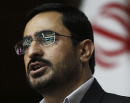
Former Prosecutor of Tehran Saeed Mortazavi was indicted but never tried for his role in torture and deaths that took place at Kahrizak Detention Center.
On 28 July 2009, authorities admitted to widespread use of torture and cruel treatment at Kahrizak Detention Center and closed it after news went public that the son of Abdolhussein Rouhalamini, a high-ranking Revolutionary Guard commander, was amongst those killed under torture in the facility.55 Despite a June 201056 conviction of two Kahrizak guards, no commanding officer or ranking official has been prosecuted for the tortures, including former Tehran Prosecutor Saeed Mortazavi. A January 2010 parliamentary report found that Mortazavi was primarily responsible for abuses at Kahrizak and although he was indicted by a special Judge’s Court, he never faced trial.57
Furthermore, officials have ignored or failed to adequately investigate credible allegations of extensive torture and ill treatment at other prisons, including Evin Prison, Rajaee Shahr Prison, and other prisons in the provinces, as well as several secret detention centers controlled by the Revolutionary Guards and the Intelligence Ministry. In August 2009, when former speaker of the parliament Mehdi Karroubi presented Iranian officials with several documents detailing multiple reports of rape and sexual abuse of detainees by security personnel, a parliamentary investigation dismissed the allegation after less than 48 hours.58
——
Back to Main———————————Next Section: Arbitrary Detention of
—————————————————————————Government Critics
————————————————————