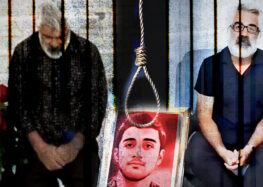
End Enforced Disappearance of Opposition Leaders
Judiciary must clarify their condition and legal situation
 (26 February 2011) The International Campaign for Human Rights in Iran called for the immediate release of Zahra Rahnavard, Fatemeh Karroubi, Mir Hossein Mousavi and Mehdi Karroubi who have been removed to an unknown location—reportedly a “safe house”– from their homes. Under international law, the secret holding of the four opposition figures is an enforced disappearance.
The four opponents of the government had been confined in their homes under an illegal “house arrest,” with no arrest warrant, summons or charge, since before 14 February, when they called for public demonstrations in solidarity with Egyptian and Tunisian pro-democracy activists.
“The four prominent people have been disappeared; they are being held incommunicado in an unknown location, a severe breach of Iranian and international law,” stated Aaron Rhodes, a spokesperson for the Campaign.
“Given the lynch mob-like calls for their execution by numerous Iranian politicians and clerics, there is reason to be deeply concerned for their safety and well being,” he said.
An informed source told the International Campaign for Human Rights in Iran that the four political dissidents are no longer under “house arrest” and have been moved to a “safe house” in an area close to Tehran. He added that their detention location is not a prison.
A “safe house” is considered a place for the secret detention of high security- value detainees, which is not under the control of the Judiciary or any other monitoring mechanisms. The Revolutionary Guards and Iranian intelligence agencies are well-known for using safe houses for all methods and techniques to get confessions from detainees without scrutiny or pressure from other legal bodies. Given the use of so-called safe houses to mistreat opponents of the government in the past, the Campaign finds it deeply disturbing that the four opposition figures have reportedly been removed to such a facility.
One of Mehdi Karroubi’s neighbors told the Campaign that there are no security forces present on Karroubi’s street any longer. “I am certain that they are no longer inside their home. All the windows are broken and nobody is home,” his neighbor said.
An eye witness in Tehran’s Pastor neighborhood, where Mir Hossein Mousavi and his wife Zahra Rahnavard live, also told the Campaign that no comings or goings into the house on Akhtar Alley had been observed. Iron bars were installed on the alley leading to the couple’s home last week, barring any traffic into and out of their property.
No official source has yet assumed responsibility for the abduction of the four reformist figures. Some reports received by the Campaign indicate that the Islamic Revolutionary Guard Corps, which led the brutal crackdown on citizens protesting the tainted 2009 presidential election, is responsible for holding them in a secret location.
“Their enforced disappearance and removal to a secret place of shows the inability of the Iranian Judiciary to protect the rights of citizens from abuse by security agencies,” Rhodes said.
The Campaign believes that with the attention of the international community focused on events in Libya, Iranian authorities have moved to neutralize the opposition leaders as the people of Iran have again massively raised their voices against human rights violations by the government. While demonstrations on 14 and 20 February were met with violent repression resulting in at least three deaths, new demonstrations have been announced for the coming three Tuesdays.
The Islamic Republic endorsed a 25 February statement by the Organization of the Islamic Conference (OIC), which demanded an end to violence against Libyan civilians and human rights violations there, and noted, “The world is witnessing far-reaching developments in a number of OIC countries at present. It is a time of awakening; a time for reckoning. Muslims will no longer be denied their rights.”
“All members of the OIC and of the wider international community need to think of the fate of Zahra Rahnevard, Fatemeh Karroubi, Mir Hossein Mousavi and Mehdi Karroubi, and to demand accountability for their legal treatment and safety from the Iranian government,” Rhodes said.
Note: This article was updated on 27 February 2011, to reflect the active role of Zahra Rahnevard and Fatemeh Karroubi as opposition figures.