Unprecedented Death Sentence for Christian Pastor on Charge of Apostasy
“Apostasy” Not Even a Crime Defined in Iranian Laws
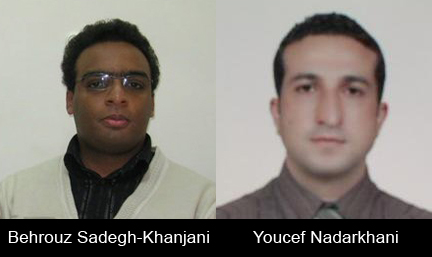 (7 December 2010) The Supreme Court of Iran should immediately reverse the apostasy conviction and death sentence of Christian pastor Youcef Nadarkhani and release him from prison, the International Campaign for Human Rights in Iran said today. The judiciary should also release another pastor, Behrouz Sadegh-Khanjani, who faces a similar prosecution.
Nadarkhani, 33-year-old who became a Christian at age 19, is a member of the Church of Iran ministry and the pastor of an approximately 400-person congregation in the northern city of Rasht. Despite being sentenced to death for apostasy, no articles in the Iranian legal code refer to such a crime.
“It is the low point of any judicial system to sentence a person to death outside of its own legal framework,” said Aaron Rhodes, a spokesperson for the Campaign.
“To execute someone based on the religion they choose to practice or not practice is the ultimate form of religious discrimination and disregard for the freedom of conscience and belief,” Rhodes added.
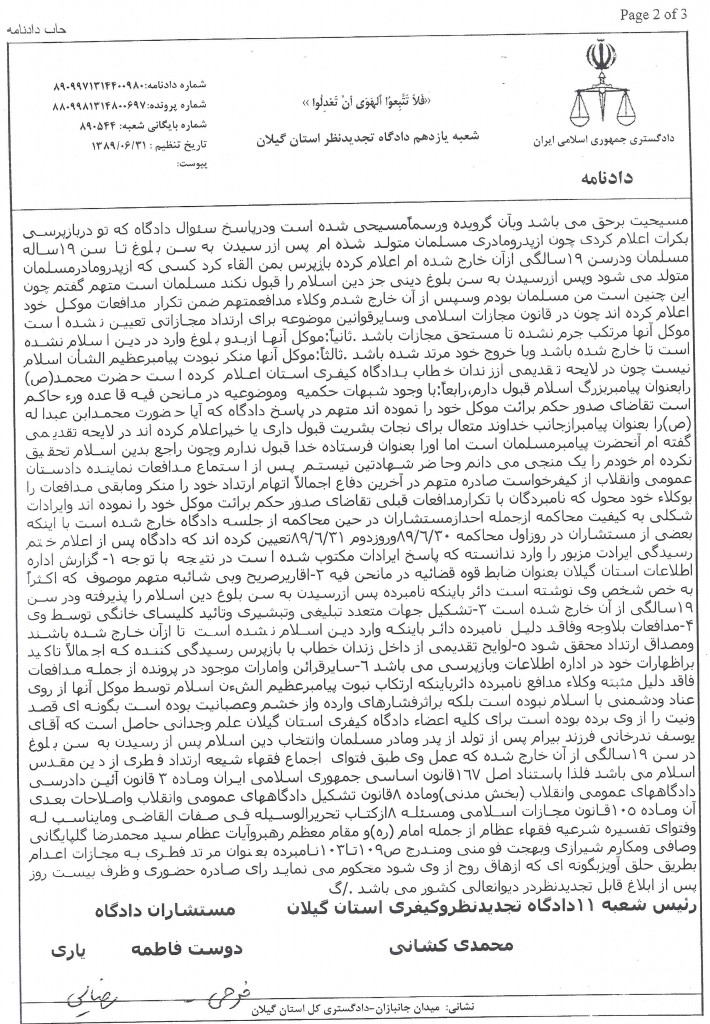
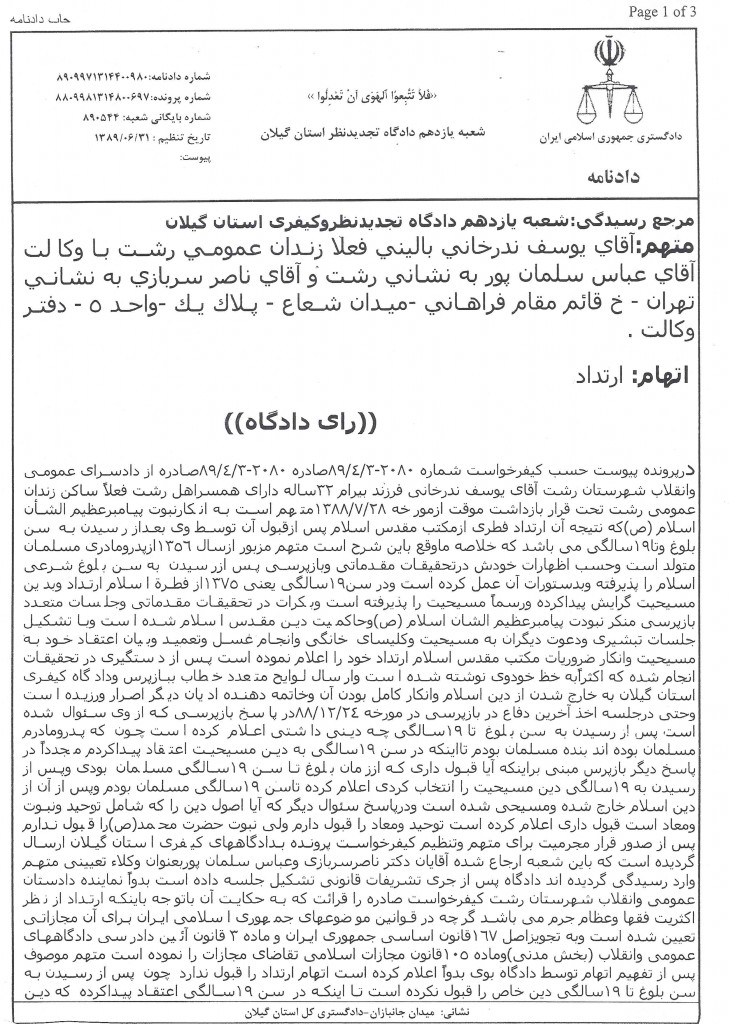
On 22 September 2010, the 11th Circuit Criminal Court of Appeals for the Gilan Province upheld the death sentence and conviction of Youcef Nadarkhani for apostasy.
Apostasy, the act of renouncing one’s religion, is not a crime under Iran’s Islamic Penal Code. Instead, the presiding judge in Nadarkhani’s case rested his opinion on texts by Iranian religious scholars.
According to the judgment, Nadarkhani was born to Muslim parents but converted to Christianity at 19. The judgment stated that during interrogations Nadarkhani made a written confession admitting he left Islam for Christianity. But at his trial, Nadarkhani said his interrogators pressured him into making the statement.
“I am not an apostate … prior to 19 years old I did not accept any religion,” Nadarkhani said at trial. After repeated questioning, “my interrogator coaxed me [into thinking] that a person who is born to Muslim parents, and does not accept a religion other than Islam before reaching the religious maturity age [15 for males], is automatically a Muslim.”
On Sunday, 5 December 2010, Nadarkhani’s lawyer filed an objection to his client’s sentence with Iran’s Supreme Court.
Articles 13 and 26 of the Islamic Republic’s constitution recognize Christianity, granting Christians the right to freely worship and form religious societies. Article 14 obligates the Iranian government to uphold the equality and human rights of Christians.
The judge in Nadarkhani’s criminal cases grounded his decision on provisions in the Constitution and the Revolutionary Court’s civil procedures that instruct judges to consult sources when there is no codified-law that addresses a matter. The judge also cited a provision in the penal code that allows judges to draw upon their personal knowledge when adjudicating cases.
“More and more, the Iranian judiciary is departing from any recognized form of due process, issuing arbitrary judgments based on vague, open-ended laws,” said Rhodes. “Laws and evidence are increasingly irrelevant and unrelated to judicial outcomes in Iran.”
Another Christian pastor, 33-year-old Behrouz Sadegh-Khanjani, is facing a possible indictment for apostasy in the southern city of Shiraz.
Referring to Nadarkhani and Sadegh-Khanjani’s cases, Firouz Sadegh-Khanjani, brother of Behrouz and member of the Church of Iran’s Executive Council, told the Campaign, “This is part of a greater trend of persecution against Christians.”
“My brother was arrested in June 2010. Eight members of his congregation including his wife were arrested two days later but were eventually released,” Firouz Khanjani told the Campaign. “For several months he was in solitary confinement; we had no word from him and he had no contact with his lawyer. He has been moved to [prison] but we worry about the type of pressure he was under while in solitary confinement.”
After his release from solitary confinement, Behrouz Sadegh-Khanjani and his lawyer, Mahmoud Taravatrooy, attended one pretrial investigatory hearing [dadsara] where prosecutors sought to indict him for apostasy along with the crimes of acting against national security, propaganda against the regime, and insulting sanctities.
“We are most concerned with the apostasy charge,” said Taravatrooy. “In preparing [my client’s] defense, that’s where most of my energy has gone, to save him from death.”
According to his brother, Sadegh-Khanjani was born to Christian parents and was never a Muslim. Behrouz Sadegh-Khanjani’s mother is a Christian immigrant from the Congo and his father converted before he was born.
“Technically speaking, the court should dismiss this charge,” said Taravatrooy, “but the judge has to review the accusations first.”
“We asked some top clerics to issue opinions on [apostasy under Islam],” Taravatrooy told the Campaign. “Four Ayatollah’s [including the late Grand Ayatollah Hossein-Ali Montazeri], said that changing one’s religion from Islam to one of the Abrahamic religions [including Christianity], is not construed as apostasy and [the convert] should be treated the same way as people of other religions would be.”
Authorities placed Behrouz Sadegh-Khanjani under temporary detention on 6 June 2010 after he reported on a summons to the revolutionary court in Shiraz. At the time he was free on bail stemming from a December 2009 arrest. Taravatrooy told the Campaign that Sadegh-Khanjani’s temporary detention order expired on 18 October 2010. “Technically he is being held illegally.”
The Campaign called for the immediate release of Nadarkhani and Sadegh-Khanjani and for an end to prosecutions on the charge of apostasy, which does not appear in any Iranian laws and violates Iran’s human rights obligations.
*Correction on 13 December 2010: the ages of Youcef Nadarkhani and Behrouz Sadegh-Khanjani were incorrectly stated as 32 and 35, respectively. Both men are 33 years of age.
———————————————————————————————————