Human Rights Crisis Requires International Scrutiny
Joint Statement by Human Rights Groups
(28 October 2010) In the light of the severity of the human rights situation in Iran, the Iranian authorities’ refusal to cooperate with existing international human rights mechanisms, and their rejection of many specific recommendations from member states under the Universal Periodic Review (UPR) at the Human Rights Council, Amnesty International, Democracy Coalition Project, Human Rights Watch, the International Campaign for Human Rights in Iran and the International Federation for Human Rights and its affiliate, the Iranian League for the Defence of Human Rights, call on the United Nations General Assembly to:
• request the UN Secretary-General to issue a more comprehensive report on the human rights situation in Iran;
• request the Secretary-General to report periodically to the Human Rights Council on the human rights situation in Iran;
• urge the UN special procedures mandates to report periodically to the Human Rights Council on the human rights situation in Iran;
• appoint a special envoy of the Secretary General with a mandate to investigate and report on the human rights situation in Iran.
The mass human rights violations that unfolded in Iran after the disputed presidential election of 2009 were a reminder of the precarious nature of fundamental freedoms in the country. The authorities imposed severe additional restrictions on freedom of expression, association and assembly. Peaceful demonstrations were banned and protestors beaten, arbitrarily arrested and in some cases shot. Scores were killed, both in the streets and in custody.
The Iranian authorities subsequently tried hundreds unfairly, including in mass “show trials”, the main aim of which appeared to be to validate their version of events and identify scapegoats. In January 2010, two men convicted after “show trials” were executed for their involvement in demonstrations, despite their having been in custody since before the election. At least seven men and one woman remain on death row for alleged offences related to the election and its aftermath, while others have been sentenced to prison terms of up to 15 years after conviction of vaguely worded “offences” relating to “national security”. Their trials make a mockery of justice.
The trials typically take place after defendants have been held for long periods of detention – often in solitary confinement or incommunicado detention – in centres where torture and other ill-treatment are common. Poor prison conditions, including denial of adequate medical care, have also been used to bring further pressure to bear on those held and their families.
Since the adoption of the last resolution on the human rights situation in Iran, the authorities have banned some political parties; closed down newspapers; targeted human rights organizations; arrested journalists, trade unionists and human rights activists and left detainees without adequate representation as lawyers themselves had their own rights violated through arrest or harassment in an apparently deliberate attempt to undermine the role of defence counsel.
The authorities succeeded in quashing demonstrations by the end of 2009, but they continue to harass or arrest critics of the government’s human rights record and others who have expressed dissenting views, many of whom have been arbitrarily detained. The authorities have arrested women’s rights activists and sentenced them to prison terms. They have also arrested members of Iran’s ethnic minorities who have advocated for greater respect of their rights, against a backdrop of violent attacks mainly in predominantly Baluch and Kurdish areas. Members of religious minorities, particularly from the unrecognized Baha’i community, Christian converts from Islam, and Sufis have been arrested and sometimes sentenced to long prison terms.
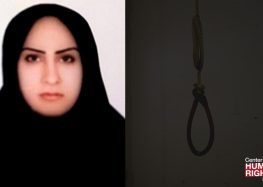
The Iranian authorities have continued to execute more prisoners – mostly by hanging – than any country other than China. Persons belonging to minorities, including foreign nationals – particularly Afghans – figure heavily among those on death row. Many of those executed have been convicted of murder or drug smuggling after deeply flawed trials. The death penalty may also be imposed for “offences” that have no inherent lethal intent – such as “adultery while married”, “sodomy”, “insulting the holy sanctities” and “establishing or membership of a group which aims to harm national security” – in violation of international human rights law. At least six people have been stoned to death for “adultery while married” since 2006. In 2009, Iran executed at least 388 individuals, including at least five juvenile offenders. Between January and October 2010, Iran executed over 220 people, including one who may have been a juvenile offender.
At least 141 juvenile offenders are currently under sentence of death for crimes that they allegedly committed when they were below 18 years of age, in violation of Iran’s treaty obligations under international law.
While the Iranian authorities have acknowledged that after the presidential election some abuses occurred in the Kahrizak detention centre, as well as in the Tehran University dormitories, they dismissed other allegations of torture – including allegations of rape – and of unlawful killings after cursory investigations. Indeed, the evidence suggests that the authorities have no intention of uncovering the truth: they have closed down the offices of persons collecting evidence of violations, and arrested some of them; they have opened a court case against defeated presidential candidate Mehdi Karroubi, who has continued to raise concerns about human rights violations; and they have brought forward persons falsely claiming to be among those listed as having died, in order to discredit evidence collected.
At the same time, the authorities are doing their utmost to prevent outside scrutiny of events, including by refusing to cooperate with international human rights mechanisms of the United Nations, while proclaiming that they are respecting their international obligations.
Iran’s standing invitation issued to all mechanisms in 2002 coincided with the end of the country-specific mandate on Iran at the Human Rights Commission. However, the seven mechanisms which have outstanding requests to visit are being obstructed in their attempts to do so. No special procedure has been permitted to visit since 2005. Indeed, the government expressly refused to accept recommendations calling for visits by some of the mandate-holders made during its Universal Periodic Review process in February 2010.
The Special Rapporteurs on torture, the independence of judges and lawyers, freedom of opinion and expression and human rights defenders, as well as the Independent Expert on minority issues, have all made requests to visit but have received no response. Meanwhile, the Special Rapporteurs on extrajudicial, summary and arbitrary executions and on freedom of religion and belief, as well as the Working Group on enforced and involuntary disappearances, have agreements in principle to visit, but the Iranian authorities have not proposed any dates.
While recognizing that Iran has submitted all outstanding reports to relevant treaty bodies, and had its human rights record considered during the UPR process and by the UN Committee on the Elimination of All Forms of Racial Discrimination in August 2010, these mechanisms are not equipped to address adequately a human rights crisis like the one which continues to unfold in Iran.
During the UPR review at the UN Human Rights Council, the government not only gave a grossly distorted account of the situation in the country; it rejected key specific recommendations on freedom of expression, association and assembly, which it denounced as politically motivated, while accepting other more generic recommendations.
In light of this track record, any Iranian initiative ostensibly aimed at increasing cooperation with human rights mechanisms, such as the invitation to the UN High Commissioner for Human Rights and the prospective resumption of EU-Iran human rights dialogue, must not deflect attention from the need for international demands for demonstrable improvements on the ground.
As member states of the United Nations are gathered for the 65th session of the General Assembly, they have once again been presented with compelling evidence of human rights violations in Iran collected by the United Nations’ Secretary General, as presented in his 2010 report submitted in accordance with General Assembly resolution 64/176 (1). Such evidence requires a robust response by the international community to respond to the failure of the Iranian authorities to address such serious human rights concerns and their obstruction of international scrutiny. Concerted action is needed to enable the people of Iran to gain greater access to the full spectrum of their internationally-recognized human rights.
(1) The situation of human rights in the Islamic Republic of Iran: Report of the Secretary-General, A/65/370, 15 September 2010, available at http://www.un.org/ga/search/view_doc.asp?symbol=a%2F65%2F370&Lang=E