Appeals Court Should Overturn Unjust Sentencing of Baha’i Leaders
Shirin Ebadi: Trial “Riddled with Irregularities”
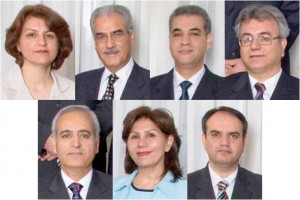
Seven Baha'i leaders imprisoned since spring 2008
(10 August 2010) Seven leaders of the Iranian Baha’i community, each of whom has been sentenced to 20 years in prison on security, espionage and other crimes, should be freed by an appeals court, the International Campaign for Human Rights in Iran said today.
“We consider the arrest, detention, trial, and sentencing of these individuals to be politically motivated, discriminatory, unjust, and illegal under Iranian and international law,” said Aaron Rhodes, a spokesperson for the Campaign.
“They have been sentenced for being Baha’is, nothing else, and their incarceration thus expresses a policy of oppression of the Baha’i Faith and its members,” he said.
The seven Baha’i leaders, who were arrested in the spring of 2008, include Fariba Kamalabadi, Jamaloddin Khanjani, Afif Naeimi, Saeid Rezaie, Mahvash Sabet, Behrouz Tavakkoli, and Vahid Tizfahm. They had been jailed for 20 months prior to being charged and denied contact with their attorneys. The sentences will reportedly be appealed.
In January 2010, in the context of the Ashura protests of December 2009 and those that had followed the June 2009 presidential election, charges against the detained Baha’i leaders were expanded. State-controlled news media claimed Baha’is had masterminded the protests, although no evidence has been produced to prove the allegations.
Shirin Ebadi, who defended the seven Baha’i leaders, told the Campaign that her clients’ prosecution was “riddled with irregularities.”
“As their lawyer, I should have had access to my clients from the time of their detention and I should have known of the charges against them. But I was not allowed to see them,” Ebadi said. She also pointed out that given the advanced age of the Baha’i leaders, their 20-year prison sentence is effectively life imprisonment, as it unlikely they will survive beyond their prison term.
Members of the Baha’i Faith in Iran number approximately 300,000, making them the largest non-Muslim religious minority group. In recent years the persecution of Baha’is has intensified to include cemetery desecration, arbitrary detention, home raids, property confiscation, work expulsion and denial of basic civil rights. Iranian Baha’i youth continue to be denied the right to higher education, and any university found to have Baha’i students is ordered to expel them. Baha’i professionals are denied government jobs and face discrimination from private businesses because of their faith. Even those who come to their defense are targeted. Shirin Ebadi has come under fire for taking up the case of seven Baha’is listed above.
According to the Baha’i International Community, there are currently 47 Baha’is in detention throughout Iran. Baha’is released on bail have been ordered to pay exorbitant amounts. For example, Aziz Samandari and Jinous Sobhani, a former secretary at the Defenders of Human Rights Center, were released on 11 March 2009 on bail of 700 million Rials (approximately $73,000). Didar Raoufi, Payam Aghsani and Nima Haghar were released on the same day and ordered to pay the same amount. Shahrokh Taef was released six days later on 17 March 2009 having paid the same amount in bail.
Diane Ala’i, of the Baha’i International Community, told the Campaign that as the Baha’i Faith is classified as an “illegal group,” many of the jailed Baha’is “are accused of acting against the country’s national security or participation in illegal groups, or teaching the Baha’i Faith.”
“All Baha’is are in danger of arrest,” she said.