Iran’s Human Rights Council Delegation’s Futile Attempts to Conceal Post-Election Abuse
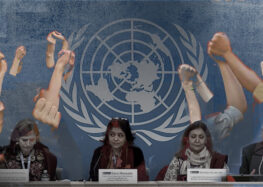
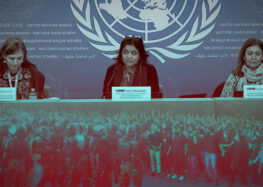
The Iranian delegation at the UN Human Rights Council session in Geneva anticipated an administrative meeting to review Iran’s periodic report about the situation of human rights in the country. They never imagined that the meeting would result in a statement by 56 countries, criticizing Iran’s arrests and executions, and requesting Iran to honor its standing invitations to UN special rapporteurs. Despite efforts by the Iranian delegation, they could not prevent the statement being read. After the statement was read, all eyes were on Iran and the deteriorating condition of human rights after last year’s presidential elections. (Read the Campaign’s statement here)
Supporting Iran or Concerned for Themselves?
In the statement, read under Item 8 on behalf of 56 nations, the Iranian government was asked to end the current violations of human rights in different areas. Only a few paragraphs into the statement, read by a representative from Norway, Iran’s name was mentioned for the first time and was met by objections by the Iranian delegation. The Iranian delegation was allowed to express their opinion that a statement under Item 8 should not have mentioned Iran specifically because according to procedures, references should be made generally and not specifically.
The Head of the Session said that so long as the points mentioned in the statement are about human rights, reading the statement is allowed. Other countries including Pakistan, Venezuela, China, North Korea, Nigeria, Sudan, and a few other countries, supported Iran’s position, saying that Iran’s name should not be mentioned in the statement. Following objections from Iran’s allies, the meeting was stopped for a few minutes, but after discussions about the issue did not reach a conclusion, the Session’s Head asked the audience to return at 3:00 p.m. to continue the discussion (about 4 hours later).
At 3:00 p.m., the Head of the Session said that the statement would be read, but that this would not set a prededent for reviewing individual states under Item 8. A representative who followed negotiations between the objecting countries and the Head of the Session during those several hours told the International Campaign for Human Rights in Iran that countries such as Pakistan objected because they were concerned that by mentioning Iran’s name a precedent would be set for naming other countries in future meetings. When they were assured that this would not be the case, they agreed to the reading of the statement. According to this source, even countries that Iran had been able to recruit for support were more concerned about themselves and once they were assured protection, stopped helping Iran.
An Iranian delegation that had come to Geneva hoping to quietly end the session in a bureaucratic way, faced a diplomatic failure.
Approval or Closure? Misrepresentation of Events at the Human Rights Council
After Iran’s Universal Periodic Review (UPR) report was reviewed at the session last Thursday, the Iranian Delegation members claimed in Iranian state TV and other governmental media that Iran’s report had been “approved.” There was no approval on the session’s agenda. Once every four years at Council sessions, the situation of human rights in all countries are periodically discussed. Each country’s human rights situation is reported by its governmental delegation, its non-governmental organizations, international organizations, and the UN High Commissioner. Depending on the items discussed, member countries make their recommendations for improvement. The countries either offer their replies at the time of the meeting, or where more in-depth analysis is required, at the next meeting. After a country whose human rights conditions are under consideration completes its periodic review, the file on that country’s situation is closed without any particular decisions or further action.
Therefore claiming Iran’s report was “approved” is inaccurate and a misrepresentation of facts. The Iranian delegation made repeated attempts to conceal and hide the many cases of human rights violations in Iran. They also tried to claim that the concept of human rights must be discussed in the context of the cultural backgrounds of nations. The Iranian delegation further attacked western countries, claiming that they use human rights for political purposes. All this demonstrated the Iranian delegation’s attempts to use the session for political gains.
Human Rights Violators and their Victims Under the Same Roof
Some countries have a critical view claiming the Council specifically targets developing countries and Muslim states for violations of human rights. This session was a unique opportunity for those countries to gain a new view. On the one hand, the Iranian delegation and its accompanying NGOs defended the current situation of human rights in Iran. On the other hand, international human rights organizations listed Iran’s violations of human rights in detail. The presence of several victims who had been illegally detained, abused and mistreated in prison attracted a lot of attention. Several representatives from different countries admitted to the deterioration of the situation of human rights in Iran after seeing the victims of prison abuse. Javad Larijani’s statements about the absence of torture inside Iranian prisons or the use of the death penalty only for severe crimes were received as hollow claims. During another meeting, which was held concurrently at the UN headquarters in Geneva, members of the International Labor Organization objected to the execution of Farzad Kamangar and the continued imprisonment of Mansour Osanloo, leaving no room for the Iranian delegation’s further denials.
The Iranian Authorities’ Widespread Political Lobby as Opposed to Accountability
The point that was not lost on participants was the Islamic Republic of Iran’s strong lobbying to enlist supporters and weaken critics. A Palestinian member of an international organization at the session told the Campaign that the Iranian delegation had held several meetings with other countries from the region to enlist their support during the meetings. According to this source, the Iranian delegation tried to emphasize the need for unity against Western countries. There were rumors about how much each vote cost, though the Campaign is unable to verify such claims. The mere discussion of such topics, however, demonstrates the Iranian government’s serious attempts to discount the violations of human rights in Iran.
Additionally, several representatives from different countries admitted that their votes at UN meetings about all issues are politically motivated. In fact, countries who have serious trade relations with Iran, are ideologically close to Iran, or in the same region, refrain from voting against Iran.
Of course, Iran does not have a very hard time enlisting the support of its ideological allies. Many of them, such as North Korea, Sudan, and China, do not have good report cards for their human rights efforts; some have an even worse track record than Tehran’s. The point Iranian authorities, including Javad Larijani, fail to understand is that Iran’s reliance on the support of such oppressive regimes in itself is indicative of Iran’s suppression of its own dissidents and widespread violations of human rights. This may be the reason why when the Sudanese or North Korean members requested time for defending Iran’s human rights situation, many participants smiled ironically. A UN diplomat told the Campaign that if Iran were in a good position, it would have never allowed any of these members to sign up in Iran’s support.