Prison Fever, Tranquilizers, and Poor Prison Hygiene: An Interview With Ali Kantoori
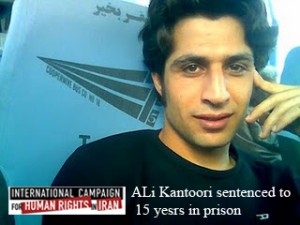
Ali Kantoori, a student activist sentenced to 15 years in prison, he has denied all the charges against him.
In an interview with the International Campaign for Human Rights in Iran, Ali Kantoori, talks about the hygienic and medical conditions of Evin prison. The human rights activist, who was detained for several months in security wards of Evin Prison and Ghezel Hessar Prison, shares his experiences at the two detention centers. Describing a phenomenon called “prison fever,” he told the Campaign that at Ghezel Hessar Prison, inmates had to wait a long time for their turn to be seen by a doctor or transferred to the prison infirmary.
Ali Kantoori was arrested in December 2007 near his residence in Qazvin, and moved to Ward 209 of Evin prison and later to Ghezel Hessar Prison. He was released in June 2009 on $150,000 bail. Before that, Sanandaj Revolutionary Courts had sentenced him to 32 months in prison on charges of propagation and mutiny against the regime and actions against national security, while another court sentenced him to fifteen years in prison. Kantouri is currently in Turkey, where he is a refugee. This is his interview with the Campaign.
What were the biggest problems with hygiene in the prison?
At Evin’s Ward 209, a bigger problem than having access to medical doctors is the psychological condition of the prisoners. I had problems several times, both psychologically and physically. I asked to see a doctor and was visited by a doctor within one to two days. But in this ward, no matter what your illness, they dispense tranquilizers – saying that the problem has to do with nerves. There is no real treatment. But the thing that is more apparent is a lack of psychological hygiene. For example, when someone is under interrogation and is under pressure by the interrogators to write some things which they want him to write, this disrupts the individual’s mental state. The interrogators are experts at this. For example, I shared a cell with Farhad Haj Mirzaee for a few days. He had been tortured and he couldn’t sleep. His rib cage hurt badly and we asked for a doctor to examine him. In the end, he was given an acetaminophen or ibuprofen painkiller. He was told “we can’t do anything for you. You hurt because of the blows you received.”
What is the personal hygiene like, for example when you were taken to Quarantine?
After my detention time at Ward 209, I was transferred to Evin prison’s quarantine area. I noticed a lot of hygienic problems there. First, because it is isolated and prisoners receive new assignments in this ward, there are no new blankets nor was particular attention paid to prisoners. It is not well-managed, and prisoners in this ward are in a state of constant transition because they have not been assigned to a ward yet. I was moved from Evin’s quarantine to Ghezel Hessar Prison’s quarantine unit. I spent my first two days there. When I was sent to the general ward, things changed a lot. The ward is comprised of small rooms and a large crowd of people have to live there in close proximity to each other. There are 14 rooms in one row, and in the section right behind this row, there are another 14 rooms. There are 28 rooms in each hall of the Ghezel Hessar General Ward. A simple illness can easily make everyone ill. A simple cold is easily transferred to everyone in the ward.
Did you get sick in prison? How did the wardens and prison infirmary staff treat you?
Two or three days after my arrival I developed a high fever and chills [ague] and I asked to be taken to the infirmary. One of the prisoners who was in charge of the ward wanted to take me to the infirmary, but he said “it isn’t our hall’s turn today. You’ll have to wait three, four days for our hall’s turn.” I waited several days and suffered from the ague until they took me to the doctor. Usually, when we asked to see a doctor, they would tell us, “It’s nothing serious! It’s Prison Fever.” Another time I developed asthma. I was coughing a lot for about a month and a half, such that it bothered me – and it bothered others because they couldn’t sleep. Where they took me was not like the Quarantine. We had to use whatever blankets there were on the floor or on the beds. When a room does not receive any sunshine, fleas take over, no matter what you do. Such an environment is prone to all kinds of illness.
Did you receive the necessary medical attention?
My family and human rights activists had brought attention to my condition. Someone from the Security Unit of Prisons Organization, and the Prison Warden came to see me and asked me, “What did you tell people outside?” I said, “I am in prison and I have no idea.” They said, “Your family has been interviewed.” During this visit, when they heard my severe coughs, they knew that I wasn’t well and they transferred me to the infirmary. So, a month and a half after the media covered the story and my family objected [switch order to “my family objected and the media covered the story”], the prison authorities paid me a visit [insert dash] during which they found out that I was ill.
How were the tranquilizers prescribed? Were they prescribed by a professional?
Ward 209 of Evin prison is not a normal prison ward. We didn’t have normal sleep [patterns] and we would ask the doctors to give us tranquilizers, and they told us not to use them. But the same doctor who would not prescribe them for me at first, when he saw my psychological state he had no choice but to give me tranquilizers.
Have the effects of your illnesses disappeared since your release?
Torture effects don’t manifest themselves immediately, or within days, months, or years. Sometimes these effect appear after a long time. I had a strange sensation in my head and in my stomach after a while. I realized after a long time that this was caused by severe stress. Psychological torture lingers much longer than physical torture. For example, if your ribs are hurt [during torture], you can go to the doctor and receive treatment for it. But my personal experience shows that psychological torture has a lot more lasting effects. Long interrogations and solitary confinement and lack of access to fresh air put the prisoner under a lot of pressure. [Regarding the use of tranquilizers] the choice is between bad and worse. Though the pills have serious side effects, if the prisoner does not use them under his dire conditions, the pressure is so high that his condition would deteriorate even further. Even if you are not under interrogation, in a 3-4 sq. meters room without sufficient lighting, where you have access to fresh air only once every several days for 15 minutes, where you don’t have access to a telephone – all these will disrupt a prisoner’s mental state somehow, and taking the pills will become the only choice.