
Human Rights Group Demands Closure of Evin Prison Court
Influence of Intelligence Agencies Restricts Basic Due Process Rights of Defendants
Lawyers Claim the Court is Unconstitutional and Illegal
(14 April 2010) The Iranian Judiciary should immediately halt the operation of a recently-established “special court” at Evin prison, which confines judges and magistrates to the prison complex and denies lawyers and families any access to judicial proceedings, the International Campaign for Human Rights in Iran said today.
“The newly-formed Evin Court has increased the influence of Iran’s Ministry of Intelligence over judicial matters by blocking lawyers’ access to clients and case files,” said Hadi Ghaemi, a Campaign spokesperson.
“This allows the interrogators and Intelligence Ministry to manipulate this institution which is itself in violation of the law,” he added.
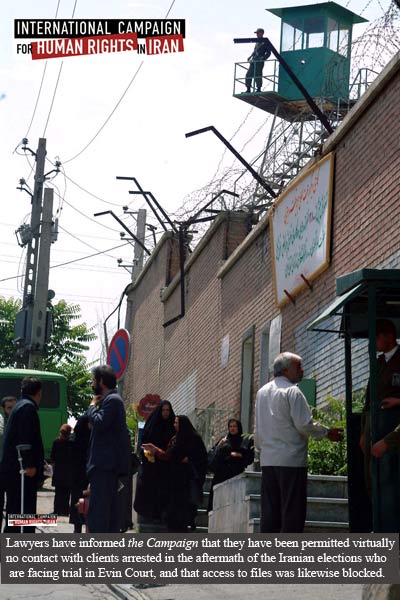
Lawyers have informed the Campaign that they have been permitted virtually no contact with clients arrested in the aftermath of the Iranian elections who are facing trial in Evin Court, and that access to files was likewise blocked. Some said they feared the restricted access reflected recommendations from the Ministry of Intelligence aimed at weakening their cases and an increased influence by the Ministry over the Iranian Judiciary.
Nasrin Sotoudeh, a lawyer in Tehran, told the Campaign that after the formation of Evin Court and the transfer of her clients’ cases there, it had become impossible for her and her clients’ families to contact the judges. “The judges are now housed in an environment that is entirely under the oversight of the Ministry of Intelligence,” stated Sotoudeh. “During preliminary investigations, which are the most difficult time during a suspect’s prison term, case judges only receive information from intelligence officers, and neither the suspect’s lawyer nor his or her family can provide any information to the judges.”
Another lawyer, Mina Jafari, referred to her clients whose files she had been deprived of reading because the court is inside the prison, including those of activists Maryam Ghanbari, Kouhyar Goudarzi, Dorsa Sobhani, and Saeed Jalalifar. She said that it had been impossible to fulfill her professional obligations as their lawyer, disappointing the legitimate expectations of their families, “which lawyers cannot oblige.”
Farideh Gheirat, a lawyer who represents some of the journalists and politicians detained after the elections, echoed similar concerns and told the Campaign:
“We lawyers have no access to Evin Court at all, as lawyers and others are not allowed inside. As a result, we cannot even have access to what little and incomplete information we were normally allowed to incorporate into [our] cases, as this is no longer possible.”
In the past, families would meet judges and other judicial staff at the Revolutionary Courts in order to provide the judge with details about the suspect’s social, psychological, mental, and familial conditions. The judge may have taken these details under advisement or not. But this important procedure, which is a normal element of a court proceeding, is impossible with respect to the judges presiding at the Evin Court.
“This has in fact made providing defense for the suspect impossible,” Sotoudeh said.
The formation of a court for political prisoners within the confines of Evin prison, where the suspect is held, informed of his charges, tried, and sentenced, is reminiscent of 1980s courts where thousands of political prisoners were tried without fair investigation, and families and lawyers of prisoners were not allowed to influence the cases in any way. Hundreds of people were executed on the basis of sentences issued by such courts.
Lawyers are responsible for attending the investigation stage of trials and for presenting any facts, which could assist judges to understand the guilt or innocence of suspects and the proper implementation of the law. When the defendant before the judge is not a legal professional, he must be accompanied by one in order to protect his rights. Iranian law reflects an understanding that if such procedures are not followed, a legal process faces serious shortcomings. Investigations without a lawyer’s presence are against Article 35 of the Iranian Constitution, and violate Article 128 of the Code of Criminal Procedures and the Law to Protect Citizen’s Rights.
On 7 March 2010, Abbas Jafari Dolatabadi, Tehran’s General Prosecutor, reported the formation of a special court inside Evin prison. Dolatabadi said the court’s formation is “based on needs,” and “a way to solve problems, expedite investigations, and reduce costs.” This court houses the case files of many political activists and unknown prisoners whose cases are in an indeterminate state.
Responding to criticism about the establishment of the court and its being called a “security court,” he said that this assertion is “wrong,” and that those who raise it either have “ill intentions” or are “ignorant.” He asserted that the Evin court is fully legal, and formed to swiftly deal with anti-revolutionary crimes. “This court will gradually reach order following the trends of current affairs,” said Dolatabadi. He also emphasized that nowhere in the law is it stipulated where courts should be located.
“Evin Court Unconstitutional and Illegal”
Over the past month, lawyers of prisoners who have not been able to find any way to review their clients’ case files have criticized the formation of the court.
Mina Jafari, lawyer to several detainees arrested in the context of post-election unrest, told the Campaign that the new court is illegal. “The formation of this court is a clear violation of the Iranian Constitution and suspects’ rights,” stated Jafari. “It is quite clear that according to legal requirements and especially citizens’ basic rights and according to Article 34, forming the Evin Court is against the law.”
Article 34 of the Iranian Constitution, establishes that it is the indisputable right of every citizen to seek justice by recourse to competent courts. All citizens have the right of access to such courts, and no one can be barred from courts to which they have a legal right of recourse.
“The Iranian Constitution, which is the parent law of the country, expresses that a court must be accessible and when it is inaccessible, according to Article 575 of the Islamic Penal Code, violators of this basic right can be prosecuted,” Mina Jafari told Campaign. “According to Article 575 of the Islamic Penal Code, whenever judiciary officials or other government officials unlawfully arrest, order an unlawful arrest, or unlawfully prosecute or charge a person, they shall be permanently barred from holding any position within the Judiciary and subjected to a five-year ban from governmental positions.”
Articles 570 through 583 of the Islamic Penal Code of the Islamic Republic of Iran list violations by authorities and government officers and ways in which violations will be addressed. Article 570 of the Code emphasizes that “any state official or authority who illegally denies or deprives people of the rights enshrined in the Constitution shall be subject to confinement terms ranging from 6 months up to 3 years in addition to discharge from government service from 3 to 5 years.”
The International Campaign for Human Rights in Iran remains deeply concerned by the erosion of standards for legal proceedings in the country, which, in making fair trials impossible, drags the Islamic Republic further way from the human rights and rule of law standards it is obligated to uphold under international law.