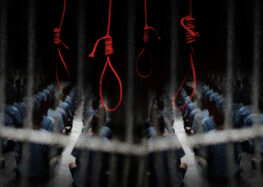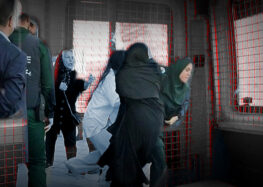
Unprecedented Remarks by Ayatollah Jannati for More Protester Execution
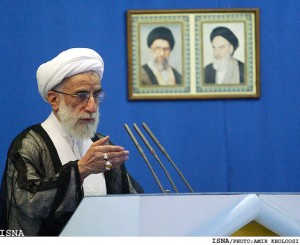 High ranking religious cleric Ayatollah Jannati, during his Friday prayer sermon on 29 January, addressed Sadegh Larijani, Head of the Judiciary of Iran, saying: “My brother. I know you well and I know you accepted your responsibilities with a good heart, intending to serve. You were seriously interested in continuing your education and you didn’t want to cut down on your studies. However, you came and you have an anti-oppression, revolutionary, and allegiance attitude. So, for God’s satisfaction, just as you executed those two individuals, thank you, stand like a man.”
Tehran’s Friday Prayers preacher continued by reading the last few verses of Ahzab Sura of the Qur’an, saying: “I talk to you through the Qur’an. God says according to a tradition which has existed in Islam and before it, three groups, meaning the duplicitous ones, sick people with a sick heart, and rumor mongers, if they persist, I order you to attack them and kill them. Of course, the law must be respected, but there should also be respect for the Qur’an and Islam, the Revolution, and vilayat-e faqih must also be maintained.”
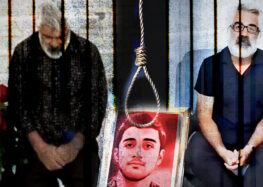
The International Campaign for Human Rights in Iran is deeply concerned that despite the vehement reactions to Mohammad Ali Zamani and Arash Rahmanipour’s executions, Jannati’s statements may be providing religious justification for judges and the Judiciary for further overt violence, above and beyond legal boundaries for punishing post-elections suspects.
As an extremist member of the Guardian Council and a high-ranking Iranian official who is responsible for coordinating laws passed by Iranian Parliament with Islamic laws, Jannati’s green light is the most blatant message for the propagation of government violence expressed by a high-ranking IRI official post elections. In the past few weeks and immediately following the violence on Ashura, a group of Parliament members supported a bill which would accelerate executions of post-election protesters; after much opposition by pro- and anti-government political parties, the controversial bill was tabled.
Even so, considering Jannati’s political position and his religious rank among pro-government supporters, such public approval of the executions of two prisoners without regard for the Judiciary branch’s independence, more than ever points to the condition of political suspects after the elections. Jannati’s statements should be viewed side by side with statements by the attorney of one of the individuals executed, who earlier told the Campaign that her client’s execution sentence was issued after an unfair investigation and amidst pressures on the suspect for forced confessions. She stated that Arash Rahmanipour was executed for crimes he had allegedly committed under the age of 18. Iran is obligated by international conventions against such executions.
The other alarming point is that Arash Rahmanipour was executed based on an indictment by former Tehran Prosecutor Saeed Mortazavi. While Saeed Mortazavi faces serious charges for violence against prisoners during post-election events, suspects under Mortazavi’s former area of responsibility are faced with executions.
Jannati also complained about the absence of execution sentences during the previous protests, saying: “We showed weakness after 18 Tir (referring to the student demonstrations of 1998 which were suppressed by the police). We must ask the Judiciary how many people were executed which led to (the protests of) Ashura? I say that if you show weakness, a worse future is awaiting you.”
In another part of his talks he added: “I hope God does not show mercy to those who show mercy to corrupters on earth. There is no room for compassion; there must be confrontation, just as when during the time of the Prophet, those who broke their promise were killed, we cannot have compromises in punishment.” He added: “Just as the Supreme Leader said, our enemies should know that people will take over their bunkers, so people should always be present.”