Release Imprisoned Cleric, End Persecution of Family
Ayatollah Khalaji, in Evin Prison for Expressing His Views, Faces Star Chamber Trial
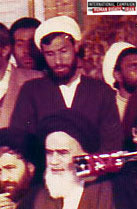
Ayatollah Khalaji standing behind Ayatollah Khomeini in Qum, 1 March 1979 (courtesy of Khalaji family)
(20 January 2010) The International Campaign for Human Rights in Iran called for the immediate release of Ayatollah Mohammad Taqi Khalaji, who was arrested on 12 January at his home in Qum, and reportedly taken to Evin prison on 19 January and placed in solitary confinement. Members of Ayatollah Khalaji’s family have been searched and threatened with punishment by authorities if they protest against his arrest.
“For what legal reason was Ayatollah Khalaji arrested?” asked Aaron Rhodes, a spokesperson for the Campaign.
“The Judiciary should release him pending an investigation of this matter in view of Article 34 of the Iranian Constitution, which prohibits arbitrary arrests,” he said.
Iranian authorities had warned Ayatollah Khalaji following public speeches he delivered after the 12 June elections, in which he mildly criticized the detention of citizens in the Kahrizak facility and prisons like Evin. Ayatollah Khalaji was close to Ayatollah Khomeini, the founder of the Islamic Republic of Iran, before the 1979 Revolution. But immediately following the Revolution, he decided not take part in government, and has never held any governmental positions.
Since the elections, several independent high ranking Shiite clerics, including the late Ayatollah Hussein Ali Montazeri, Ayatollah Yusuf Sanei, Ayatollah Seyed Jalal Al-din Taheri and Ayatollah Seyed Ali Mohammad Dastgheib have come out in support of protesters. They have condemned the government’s use of excessive violence and called for an end to hostilities against protesters, both on the streets and in prisons.
Recent pressure on Ayatollahs Sanei and Dastgheib was followed by attacks on their offices (Beits) by plainclothes Basiji forces close to the government. Pro-government clerics have also tried to challenge the credentials of such Ayatollahs in order to pave the way for further pressure.
Ayatollah Khalaji faces trial in the Special Court for the Clergy, established by Ayatollah Khomeini in 1985 to try clerics accused of committing crimes. Iranian human rights lawyers believe that according to Iranian laws there should not be any separate court for clerics or members of any other social, religious and economic groups or professions, and critics have claimed that the government uses such courts to punish clerics it views as challenging the ruling order. In any political context, special courts (“star chambers”) are considered an obstacle to equal protection under the law and fair trials.
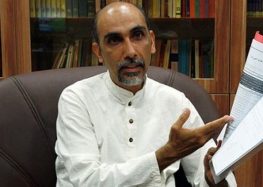
Mehdi Khalaji, son of the prominent 61-year-old cleric, told the Campaign that he believes the only reason for the theology teacher’s arrest is because of his views and opinions. He said in the interview:
“My father is an expert in Islamic and religious studies…My father has said that Islam does not allow for political prisoners; neither the Prophet nor Imam Ali ever put anyone in prison for expressing their opinions. My father believes that the regime must obtain people’s satisfaction and cannot rule with force. He does not belong to any groups, not even groups within the Seminary, no political or even religious organizations. He is not related to any groups or factions and he does not engage in political activities. The only reason he is in prison is because of his opinions.”
Post-election restrictions on freedom of speech and assembly in the Islamic Republic have been followed by the arrest of hundreds of journalists, reformist political figures, bloggers, women’s rights activists, and thousands of protesters.
The International Campaign for Human Rights in Iran called upon all authorities of the Islamic Republic to respect Iran’s laws and its international legal obligations, which protect freedom of expression and conscience, and to release all who are detained on the basis of their beliefs and opinions.