Lives of Four Students on Hunger Strike Are at Risk

Detained Students Should be Immediately and Unconditionally Released
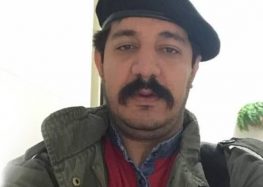
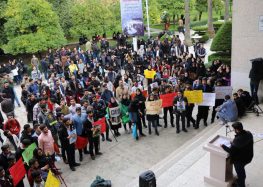
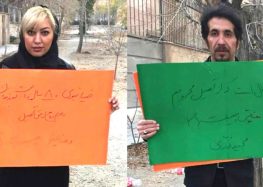
(21 February 2009) The lives of four Amirkabir University students, Majid Tavakoli, Hossein Torkashvand, Esmaiel Salmanpour and Kourosh Daneshyar, who went on hunger strike to protest their arbitrary detention, are at risk. The students should be released immediately and unconditionally, the International Campaign for Human Rights in Iran said today.
The four students are among a group of around twenty people arrested on 5 February 2009, at a ceremony to honor Mehdi Bazargan, the first Iranian prime minister after the revolution of 1979. The annual event had been announced publicly and formally by his family and Nehzat e Azadi, the political party founded by Bazargan. Two weeks before this formal announcement, intelligence forces had prevented the ceremony. However, after negotiation with parliamentarians and other authorities, the organizers were given verbal permission to hold the ceremony.
According to Ebrahim Yazdi and Ezatolah Sahabi, prominent politicians and Bazargan’s colleagues who issued invitations to the ceremony, in the last 14 years there were never any official obstacles to holding the ceremony. Although memorial ceremonies do not require any official permission according to the Constitution, the organizers sent formal letters to the Governor at Tehran and local police and informed them, receiving no denials in response. Yet on 5 February 2009, as guests were arriving to attend the ceremony, they were obstructed by police and security forces, and about 20 people were arrested violently, including the four Amirkabir students.
”We are calling upon the Judiciary to investigate these arbitrary and illegal arrests, and to release them immediately,” stated Hadi Ghaemi, spokesperson for the International Campaign for Human Rights in Iran.
Activists on behalf of the detained students at Amirkabir University reported to the Campaign that the four students are being kept in solitary confinement in ward 240 of Evin Prison, which is managed by prison authorities. However, since they began their hunger strike they have been threatened with transfer to ward 209, which is run by the Intelligence Ministry. Families of the students were not informed of their whereabouts for five days, after which Branch 2 of the Revolutionary Court informed the families that their children had been placed in detention. Reliable sources have informed the Campaign that when the students were arrested, they were accused of “disobeying police orders,” which was subsequently changed to “acting against national security by attending an illegal ceremony.”
In protest against the arbitrary detention order, the four students and three other detainees, whose names have not been published, went on hunger strike. The health of the students has reportedly deteriorated seriously; Majid Tavakoli was taken to the health unit in Evin Prison several times to receive serum while he was unconscious.
“The authorities have a positive obligation to protect the detainees’ health and safety, and they should release all who have been arbitrarily detained immediately and unconditionally,” Hadi Ghaemi stated.
The International Campaign for Human Rights in Iran appealed to the Judiciary to identify and prosecute those who ordered and implemented the detentions, which were in violation of national and international human rights laws.